

Editor’s note: The power of face to face is deeply ingrained in the history of the United States. This country, and democracy, evolved in large part because of the ability to come together, to engage in conversations – at times, arduous – to create opportunities or to solve crises. As we participate in Global Meetings Industry Day 2026, we look back at historic meetings that took place, some at ALHI hotels, in our year-long series examining issues and trends that have evolved over the course of American history as the United States celebrates its 250th birthday.
From the First and Second Continental Congress to the founding of the United Nations, meetings have shaped America – and the world – for 250 years. The meeting is the foundation of American democracy, with roots in colonial town halls and high-stakes constitutional summits.
"Democracy and the American way is at its best, at its most potent, a process. It is a coming together, a convening. It is the possibility that we will gather, that we will exchange ideas, that we will discover a sense of what is ethical, even that which is moral,” said legal and cultural historian Dr. Martha S. Jones of Johns Hopkins University in a 2022 speech in California.
She added that American democracy shouldn’t be viewed through the lens of wins and losses, but as a "perennial, long and arduous debate" centered on the act of convening.
“Democracy promises that there will be a table, that we will return to that table, and that in our own time… we have the privilege of grappling with the very fabric of who we are," she said.
Those meeting tables — starting with the First and Second Continental Congress from 1774–1776 – hosted delegates who resisted British policies and eventually wrote the Declaration of Independence. After achieving independence, delegates met again in 1787 in Philadelphia to create a new federal government and write the U.S. Constitution.
Political and Social Milestones
Since then, meetings have produced hundreds of U.S. political and social milestones, including these notable ones.
-
The Seneca Falls Convention in 1848, the first women's rights convention that started the suffrage movement.
-
Republican National Convention in 1856, the first convention of the new political party that wanted to stop the spread of slavery.
-
“The Dinner.” President Theodore Roosevelt in 1901 invited Booker T. Washington to the White House to dine with the president’s family, marking the first time a Black man was invited to dine as an equal guest of the President.
-
The International Civil Aeronautics Conference in 1928, hosted by President Calvin Coolidge, brought together aviation leaders from 34 countries to commemorate the 25th anniversary of the Wright brothers' first flight. The meeting was the first major international effort to unify aerial legislation and commercial standards.
-
March on Washington, 1963, the massive gathering for civil rights where Martin Luther King Jr. delivered his "I Have a Dream" speech.
-
The Camp David Accords in 1978, during which President Jimmy Carter brokered peace between Egyptian President Anwar El Sadat and Israeli Prime Minister Menachem Begin.
-
International AIDS Conference, in 1987, in Washington, D.C., where 6,000 researchers gathered to mark the international acceptance in recognizing HIV/AIDS.
Historic Meetings at ALHI Hotels
Several ALHI hotels are part of the rich history of U.S. meetings, from hosting political conventions to international events to top-secret meetings that determined the future of the planet.
Here are a few of ALHI hotels’ contributions to meetings in U.S. history – from the grand to the top secret – in chronological order.
1861: The Peace Congress, Willard Intercontinental, Washington, D.C.
In a desperate, last-ditch effort to avoid the American Civil War, delegates from 21 states met at the Willard just weeks before Abraham Lincoln’s inauguration in a last-ditch effort to find a compromise on slavery and secession and avoid The Civil War. The Willard is also tied to many historic events, and was the place where Martin Luther King finished writing his “I Have a Dream” speech in 1963.
1910: Foundation laid for the Federal Reserve System of centralized U.S. banking, Jekyll Island Club Resort, Ga.
In November 1910, some of the nation’s most powerful financial leaders and policymakers gathered at Jekyll Island Club Resort under the guise of a hunting trip. Invited by U.S. Senator Nelson Aldrich of Rhode Island, the group met in one of the clubhouse rooms to address U.S. financial instability exposed by the Panic of 1907. Participants used first names only to avoid public attention, later becoming known as the “First Name Club.” The men drafted a plan for a centralized banking system that would ultimately become the foundation for the Federal Reserve System. As a result of the meeting, the Federal Reserve was established by Congress three years later in 1913. The room where they met is now named “The Federal Reserve Room” and the wall displays the document instituting the Federal Reserve.
Five years later, in 1915, Jekyll Island ushered in the remote meeting era when AT&T president Theodore Vail placed the first transcontinental telephone call from the clubhouse to President Woodrow Wilson in D.C., Alexander Graham Bell in New York, Thomas Watson in San Francisco, and Henry Higginson in Boston. Listening in on the conversation at Jekyll Island were Welles Bosworth, S.B.P. Trowbridge, J.P. Morgan Jr. and William Rockefeller.
1920: Headquarters for pro- and anti-suffrage forces during the fight to ratify the 19th Amendment giving women the right to vote, The Hermitage Hotel, Nashville.
During the summer of 1920, Tennessee was the 36th and last state needed to vote to ratify the amendment. The hotel was the base for both sides and the lobbying efforts became known as “The War of the Roses.” Suffrage supporters wore yellow roses while opponents wore red roses. The Hermitage is recognized as a National Historic Landmark specifically for its role in U.S. history.
1943: United Nations Conference on Food and Agriculture, The Omni Homestead Resort, Hot Springs, Va.
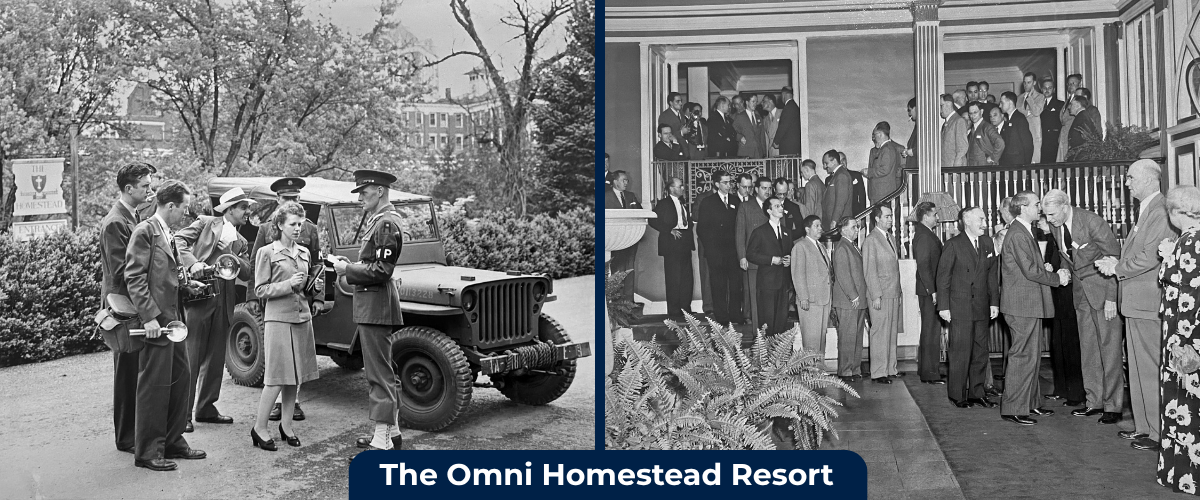
For 16 days in May and June 1943, The Omni Homestead Resort hosted 44 national leaders and a total of 161 delegates in an effort to identify “the things which had created the circumstances of strain which finally led to war,” as reported by Dr. Karl Evang, a prominent Norwegian physician and public health pioneer. The resort was closed to the public and surrounded by military police throughout. President Franklin Roosevelt addressed the conference, which declared that “the goal of freedom from want can be reached” but “it will first be necessary to win freedom from hunger.” The meeting drew extensive press coverage, and was criticized for being held at a luxury resort while gas and other food rationing was underway. In the New Yorker, U.S. delegate Josephine Schain tried to explain: “The hotel menu, like all hotel menus these days, had leaned heavily on chicken and turkey in various guises and that the meatless days were meatless.” In the end, a declaration created an interim commission with a goal to raise the levels of nutrition and standards of living and improve agricultural production and distribution.
1945: Secret meeting about the future of nuclear weapons in World War II, The Langham Huntington, Pasadena, Calif.
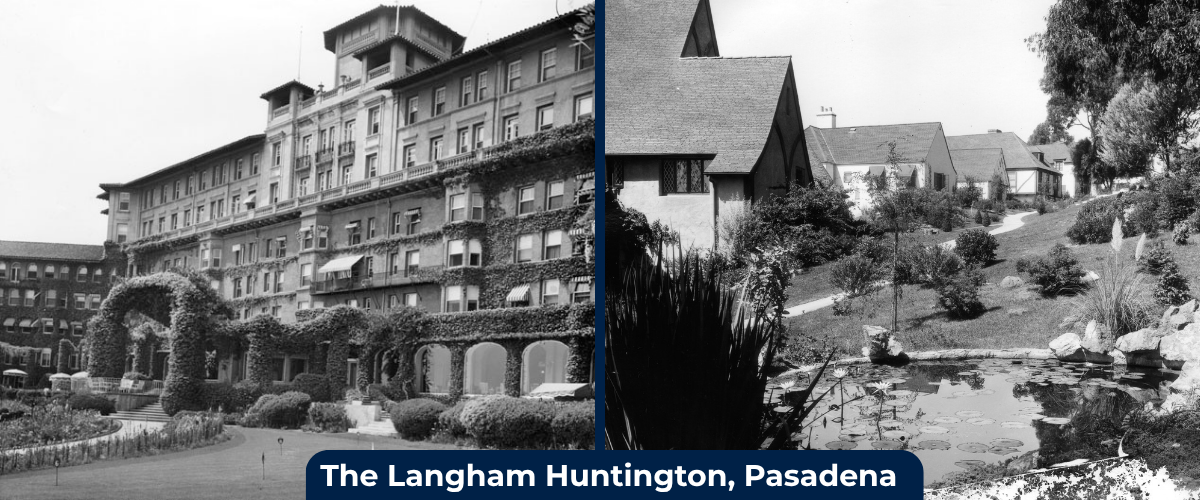
When World War II broke out, many hotels were remanded to the government to be used as military outposts and hospitals, and all reservations at the hotel were cancelled. The hotel asked the U.S. Secretary of War to allow civilian activities to continue. It did, but the East Wing became headquarters for the 35th Division of the US Army. Near the end of the war, prominent scientists, including Dr. Vannevar Bush of the Manhattan Project and Dr. Robert Oppenheimer, met in Finleen Cottage for a top-secret meeting about the future of the project following the Trinity Test of nuclear weapons on July 16, 1945. The first atomic bomb was dropped on Hiroshima, Japan on Aug. 6, 1945.
1945: United Nations Charter drafted, Fairmont San Francisco.
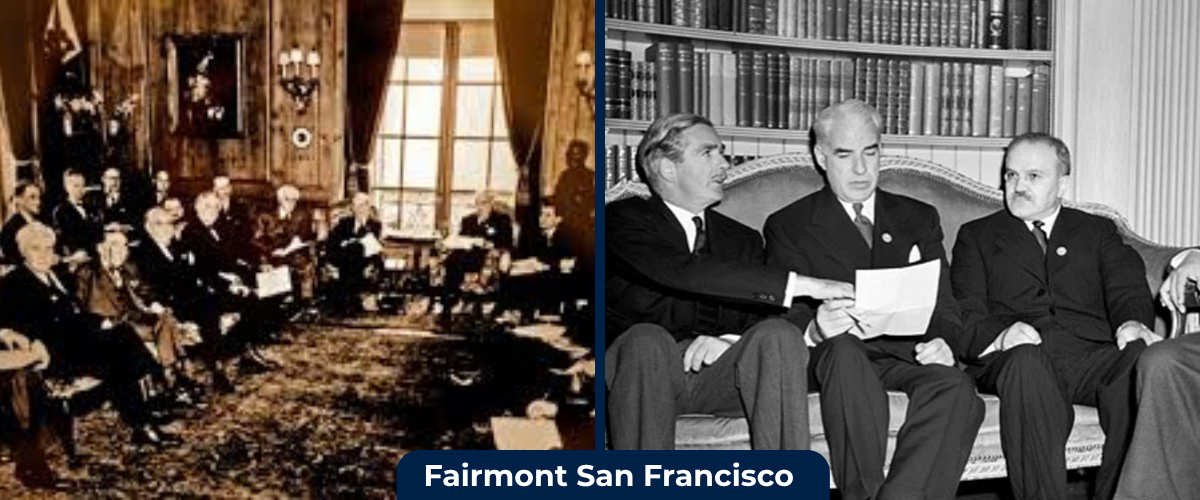
Public sessions of the United Nations Conference on International Organization were held at the War Memorial Opera House but the important backroom deal-making happened in the Penthouse Suite of the Fairmont. U.S. Secretary of State Edward Stettinius Jr. hosted delegates at the hotel to draft the United Nations Charter. A plaque in the hotel’s Garden Room today commemorates where key parts of the charter were designed and the flags of the countries fly outside.
1949: 41st National Governors’ Conference, The Broadmoor, Colorado Springs, Colo.
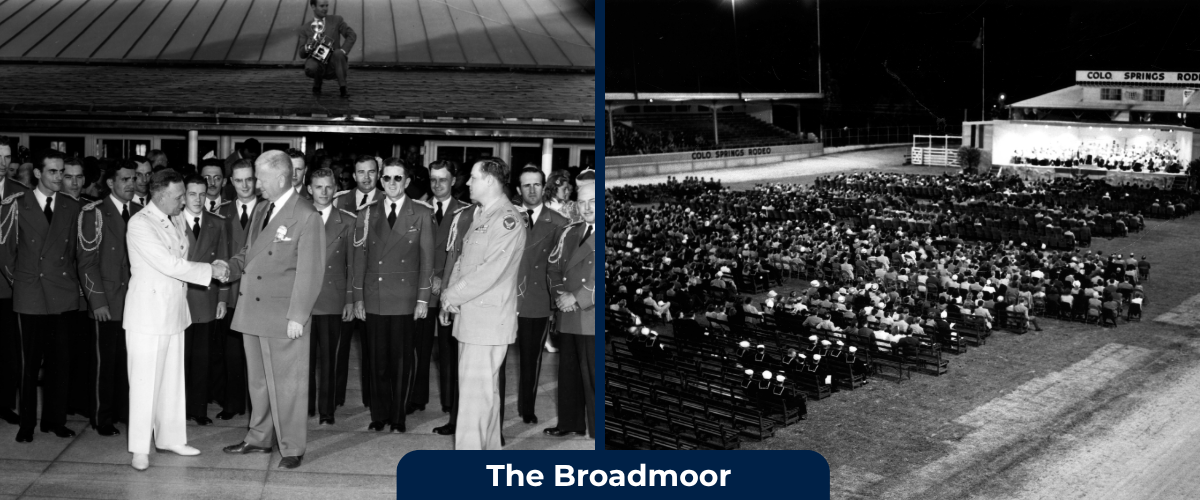
The conference focused on postwar state issues, with key discussions about Social Security reform, highway infrastructure policy and mental health reform. The conversations at the conference closely mirrored the Social Security Act Amendments of 1950, signed by President Harry S. Truman, and represented the first major overhaul of the system since 1939. Key provisions of the Act included increased benefits, expanded coverage, the inclusion of employees in Puerto Rico and the U.S. Virgin Islands as well as certain federal civilian employees, and the creation of a new public assistance category for the permanently disabled. The legislation also raised earnings limits for beneficiaries and increased grants for children.
1970: Second state dinner held outside the White House, Hotel del Coronado, Coronado, Calif.
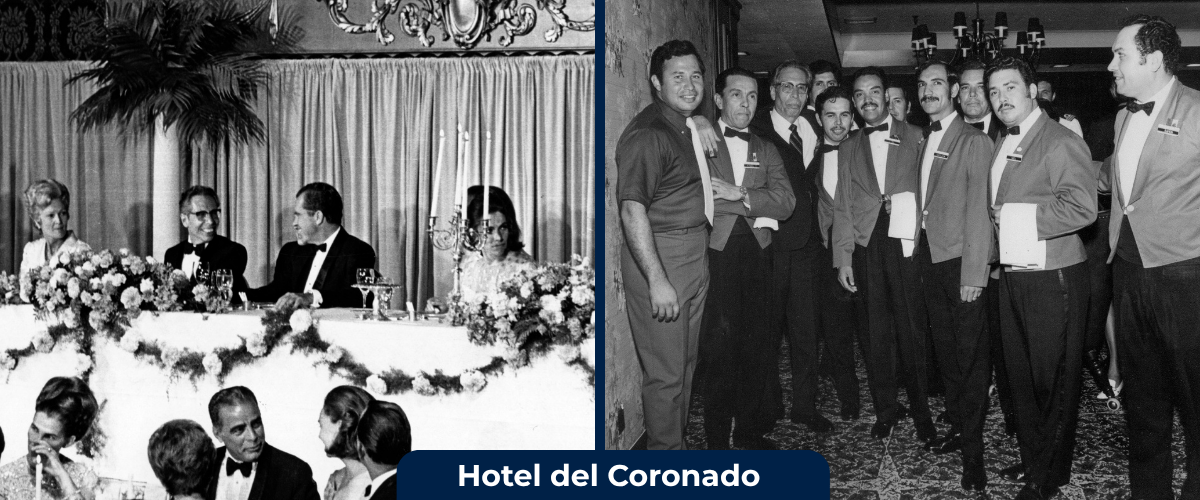
On September 3, 1970, President Richard Nixon welcomed Mexican President Gustavo Díaz Ordaz to the hotel’s Crown Room. The event was organized in just 11 days after Nixon hatched the plan during his late-August meeting with Díaz Ordaz in Puerto Vallarta. Within days the hotel was transformed into a secure diplomatic venue. At the height of the summer season, 120 guest rooms were taken over for presidential
The guest list reflected a convergence of political leadership and popular culture. Former President Lyndon B. Johnson attended alongside California Governor Ronald Reagan, cabinet officials, diplomats and Hollywood royalty. John Wayne, Frank Sinatra and Red Skelton attended, along with Dr. Seuss. The dinner was not without controversy as planners initially called for only male servers. The issue quickly drew national attention and criticism from the Women’s Liberation Movement, including Betty Friedan, was significant because it coincided with the 50th anniversary of the women’s suffrage movement. Within days, the decision was reversed and waitresses were made part of the serving staff.
1969: “Dinner of the Century” – Defining Moment in Space Age Diplomacy, Fairmont Century Plaza, Los Angeles.
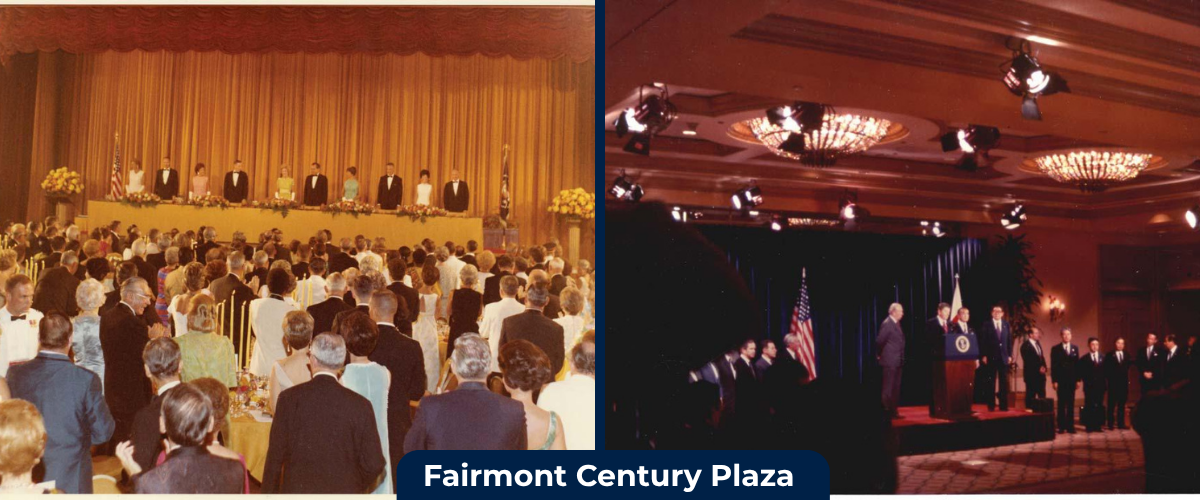
On August 13, 1969, President Richard Nixon hosted what became known as the “Dinner of the Century” at Century Plaza, in the first official Presidential state dinner ever held outside of the White House. The event honored the safe return of the Apollo 11 astronauts following mankind’s first moon landing and America’s victory in the Space Race. The gala brought together 1,440 distinguished guests, including more than 50 members of Congress, representatives from 83 foreign nations, 14 Presidential Cabinet members, as well as the astronauts’ families, and pioneers of space and aviation, alongside prominent figures from Hollywood. The evening was a powerful moment of international diplomacy and unity.
Century Plaza’s place in history later was cemented by Ronald Reagan as the “Western White House. From the 1970s through the early 2000s, the hotel became closely associated with Ronald Reagan, who frequently stayed at the property and hosted fundraisers, political events, and inaugural celebrations in its storied ballroom. The Plaza’s Presidential Suite was later named the Ronald Reagan Suite.
1994: First Summit of the Americas, The Biltmore, Coral Gables, Fla.
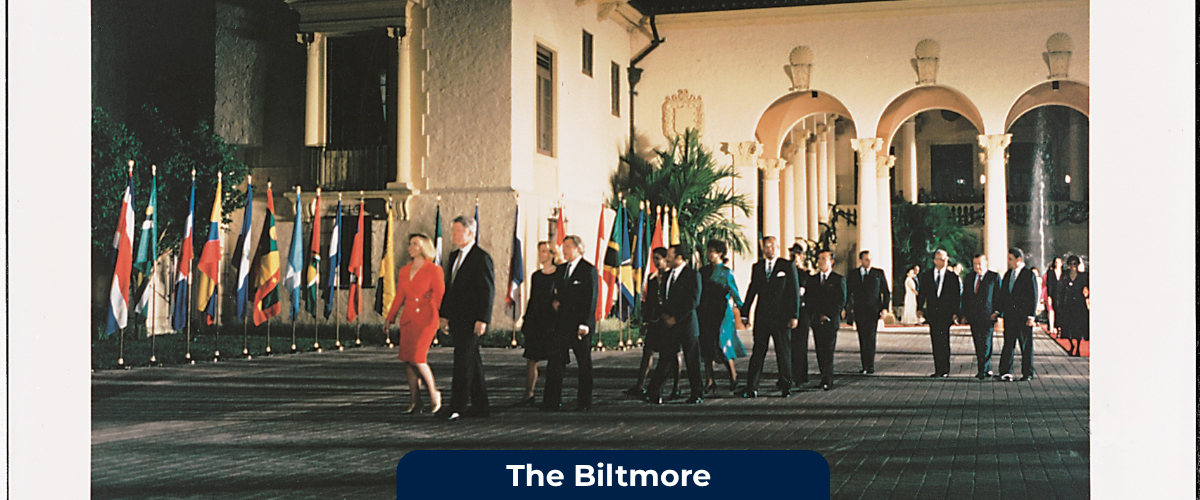
In December 1994, President Bill Clinton convened the first Summit of the Americas at The Biltmore, bringing together 34 democratically elected leaders, except for Cuba, from across the Western Hemisphere. The gathering signaled a new era of cooperation following the Cold War – after most Latin American nations had transitioned from dictatorships to democracies. The meeting was the first of its kind hosted by the U.S. and laid the foundation for expanded trade, strengthened democratic institutions, and a shared vision for prosperity that would shape inter-American relations for decades to come.
Our Series
January: Historic Hotels Helped Shape American History – and Defined Luxury
February: Evolution of Air Travel, and Airport, Shrinks the Globe & Brings People Together
March: America and Its Sports are Intertwined
More GMID Stories
Advocacy Top Priority on Global Meetings Industry Day
Recognizing Hospitality Industry Professionals on #GMID2026
Industry Facts, How to Participate